
 Wellness Hotel
 Family Hotel: fun for everyone
 Snow Hotel directly on the slopes
  Last Minute offers
  Holiday packages
Plan de Corones culture & lifestyle: Castles, Churches and Museums
Imposing castles, idyllic churches and chapels: the past must have been as exciting as our future will be. The "Ciastel de Tor" Museum in San Martino di Badia, the Museo Ladino Provinciale and the Museum of Tradition in Teodone "Museo degli Usi e Costumi" show in a particularily impressing way how the people in ancient times used to live. What they have created you can admire by touring through our area.
Reserve your favorite accommodation in Kronplatz: The Plan de Corones holiday resort has a lot more to offer than just the arts of the late famous gothic sculptor from Brunico, Michael Pacher.
-
Castle "Castello di Tures"
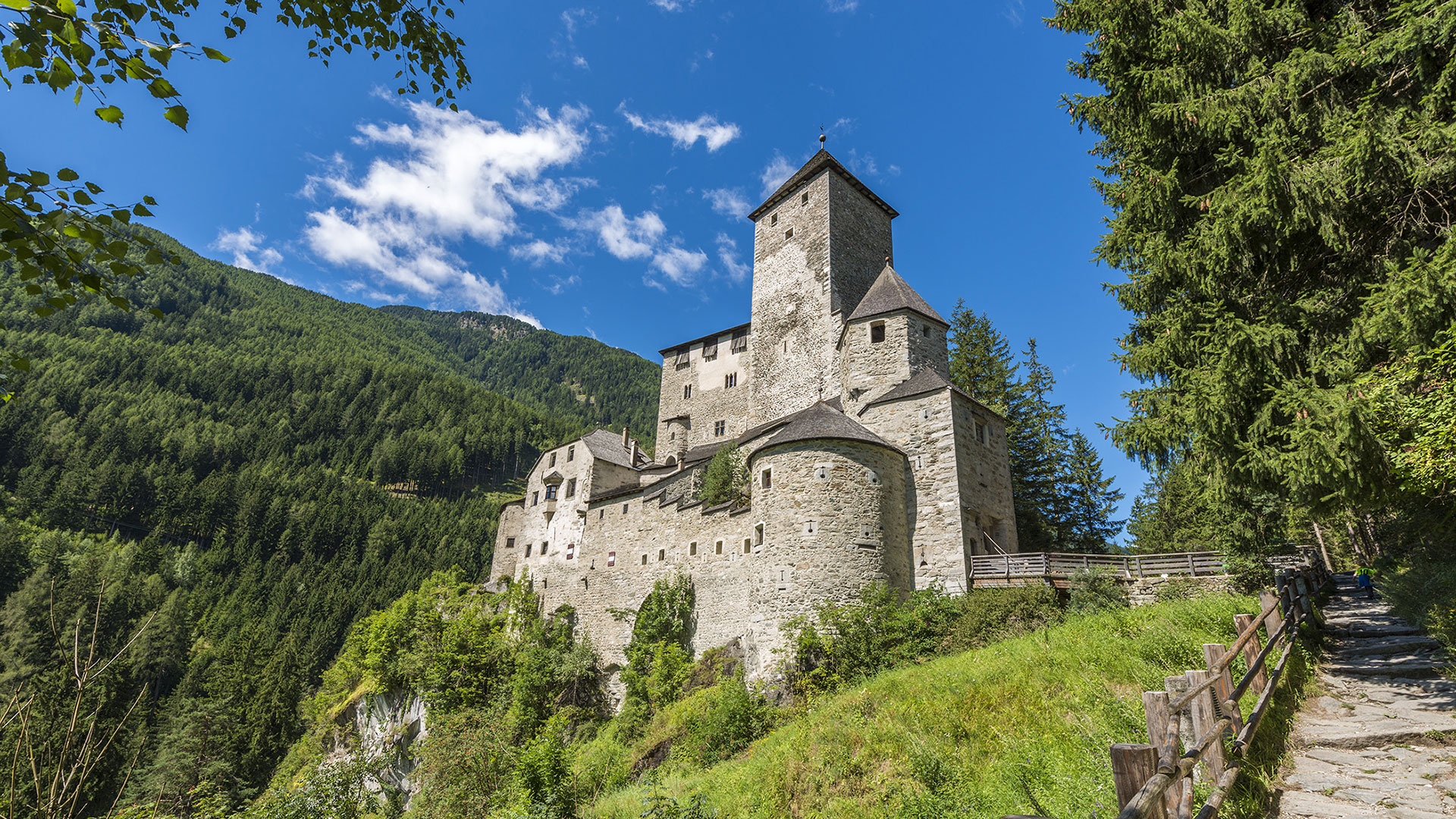
The Castle towers at the entrance to the Valle Aurina Valley. It is crowned by the glaciers of the Aurine Alps and surrounded by forests. At the bottom of the Castle lies the beautiful village of Campo Tures and the vast green Campo di Tures hollow. This is the image that awaits all visitors of the area. Merloned walls and a round arch make it impossible to cross the road that once went past the castle. The path of the castle leads you across a drawbridge over the castle moat, and through a big lancet door into a square court with a round tower at each side.
On top of the doors and at the towers you can see the trap-door, from which hot liquids and various other objects, that were once used for protective purposes, were spilled or dropped down onto any daring would-be enemies. Further on, another drawbridge and three gateways can be found. The square tower with the big gate, the two round towers, the battlement parapet to the South and the south-west track (period of construction: the oldest walls date back to the 11th Century, the arched windows to the middle of the 13th Century and the gothic part was built between 1483 and 1541) date back to the 2nd period. - In the castles court you can see a picturesque fountain, covered by an octagonal roof built in the shape of a pyramid. It is very likely that this used to be a forge.
Also the so-called granary is located in the court. It is a high building with three rows of gothic windows over the ground floor. In the south-west track, which is well restored, some habitable areas con be found. The Masters of Tures, a noble family and one of the most famous houses in Tyrol, used to live in the castle before the 13th Century. The Tures family died out way back in 1340.
In 1977 the castle became the property of the Südtiroler Burgeninstitut (South Tyrolean Castles Institute). During the 15th and 16th Century the castle was used as a home. The castle is completely furnished and it was preserved very well. That is why the Castello di Tures Castle is considered to be one of the biggest and most beautiful castles in the whole Tyrolean area. About two thirds of the 64 rooms are paneled with wood. The fresco-paintings of Friedrich Pacher in the chapel are particularly precious.
Castello di Tures Castle
Via Winkel, 4
39032 Campo Tures
Phone: 0039/0474/678543This email address is being protected from spambots. You need JavaScript enabled to view it.
www.burgeninstitut.com -
Erborista Bergila (Herbs)
Visit the pine oil distillery in Issengo. Since 1912 old traditional distillation methods have been followed and adhered to. In our old distillery you will have the possibility to observe the old distillation process, by which we distill our essential oils. Furthermore, you can visit our herbs garden, where we cultivate more than 70 different officinal herbs in accordance with the moon phases of the Maria Thun moon calendar.
Bergila, by Niederkofler Franz
via Treyen, 9 - Issengo
I - 39030 Falzes (BZ)
Phone: +39 0474 565 373
Fax:+39 0474 561 591 -
Aurina Valley - Museo mineralogico (Mineral Museum)
Numerous samples of minerals from the Alti Tauri mountains, carefully collected by Josef Kirchler over the last few decades, provide evidence of how the Alps were formed. The more than 750 exposed minerals were found in the Zillertal Alps and in the Alti Tauri mountains:
rock crystals represent the ideal crystal and their transparence is a reminder of the eternal ice on the highest peaks, of feldspars, sparkles, violet amethyst, fluorides, apathetic diamonds, emeralds and titanits, which enchant every observer by their deep green.
Amongst the biggest smoked quartz in South Tyrol, the famous rock crystal 'ritorto' from the Predoi mine can be found.
Museo mineralogico
S. Giovanni, 3
39030 Valle Aurina
Phone: +39/0474/652145 - Fax: +39/0474/652011This email address is being protected from spambots. You need JavaScript enabled to view it.
www.mineralienmuseum.com -
Brunico - Museo civico (Civic Museum) of Brunico
The museum was re-founded in 1990 and reopened in 1995 in the former stables of the post office. The Civic Museum in Brunico had been first founded in 1912. During the fascistic period the museum was closed (1939-40) and most of the objects were brought to Bolzano. The new museum re-obtained part of the artistic collection of the old Civic Museum, including sculptures and paintings of Michael and Friedrich Pacher. Also, the collection of modern graphics of local modern artists is also of great value for the museum. The museum has dedicated one section to the 'graphic and literature' of many modern writers and artists.
Museo civico di Brunico
Via Bruder Willram, 1
39031 Brunico
Phone: +39/0474/553292 - Fax: +39/0474/410685This email address is being protected from spambots. You need JavaScript enabled to view it.
www.eck.museum -
Brunico - Museo etnografico (Ethnographic Museum)
The ethnographic museum was founded in 1976 and it is one of the oldest provincial museums in South Tyrol. Houses of the middle class and of the lower class can be seen at the imposing residence Mair am Hof, and at the open museum, and also some primitive technical inventions from ancient times. In the civic museum you will have the possibility to explore the past through a socio-cultural aspect on a trail that leads through all of the main stages of life on farms, in the country side and in workshops.
Museo etnografico
Via Herzog Diet, 24
39031 Teodone
Phone:+39/0474/552087 - Fax:+39/0474/551764This email address is being protected from spambots. You need JavaScript enabled to view it.
www.volkskundemuseum.it -
Dolomythos
Presentation of the Dolomites, which represents living and cultural space, through fossils, minerals, myths and legends.
39038 San Candido
Tel. 0474/913255
Fax 0474/913092
Open all year -
San Candido - Museo della Collegiata di San Candido
This house which stands in the shade of the church of the San Candido Convent, is one of the oldest buildings in Upper Puster Valley. The museum, the archive and the library of the San Candido Brotherhood are situated in this building. The Dome`s treasury, the holy art of the church and a collection of manuscripts are the remains of the intellectual and spiritual work of the oldest brotherhood in Tyrol. Most of the precious objects are pieces of work by local artists who created them on the instructions of the canons or of the then land owners from San Candido.
Museo della Collegiata di San Candido
Via Atto, 3
39038 San Candido
Phone:+39/0474/913278 -
Villabassa - Museo del turismo of the Upper Puster Valley (Touristic Museum)
Villabassa has had a pioneer`s role, which started 150 years ago, in the development of tourism in the Tyrolean region and in the Upper Puster Valley thanks to the train connections of Villabassa with many major cities. The museum is located in the Casa Wassermann House and it affords you the opportunity to get to know the story of tourism which was open only to the well off, up to modern day tourism, with examples of the first touristic places (old hotels and guesthouses, numerous thermal baths) and the construction of the rail way in Puster Valley and the origins of alpinism in the region.
Touristic Museum in the upper Puster Valley
Casa Wassermann
Via Hans Wassermann 8
Phone:+39/0474/745136 - Fax: +39/0474/745283This email address is being protected from spambots. You need JavaScript enabled to view it. -
Campo Tures - Parish Museum Taufers
The Parish museum is located beside the parish church in Campo Tures. Back in the times of the nobles from Tures, the two buildings were already being used as a store room for the tens of collections that were divided between the lawyer of the Signori di Tures and the priest of the canon. In 1984 Dean Munter assembled a large number of pieces of art from the churches and chapels of Campo Tures in this store room. The objects on show are not real exhibition pieces of a museum since they are still used for liturgical purposes. A visit to the museum finishes off with the arrival at the parish church, a late gothic master piece.
Parish Museum Taufers
Via Parrocchia, 14
39032 Campo Tures
Phone:+39/0474/678060This email address is being protected from spambots. You need JavaScript enabled to view it. -
Rudolf-Stolz-Museum
In two rooms, the museum of Sesto which was opened in 1969, shows mainly projects and sketches of many fresco paintings, water-colour paintings and graphical works of the famous South Tyrolean painter Rudolf Stolz (1874-1960). Amongst his main works are 'danza della morte' (Dance of Death) in the cemetery in Sesto, and several fresco paintings on the arches of the cemetery. In honor of his pieces of work the Municipality of Sesto built a museum in the central square. The museum was planned by the painters son in law, the architect Erich Pattis. The painters daughters donated more than 160 of his pieces of work to the museum after his death.
Moos, Dolomitenstraße 16
39030 Sexten
Tel. 0474/710521
Fax 0474/710318 -
Ladinisches Landesmuseum - Schloss Thurn
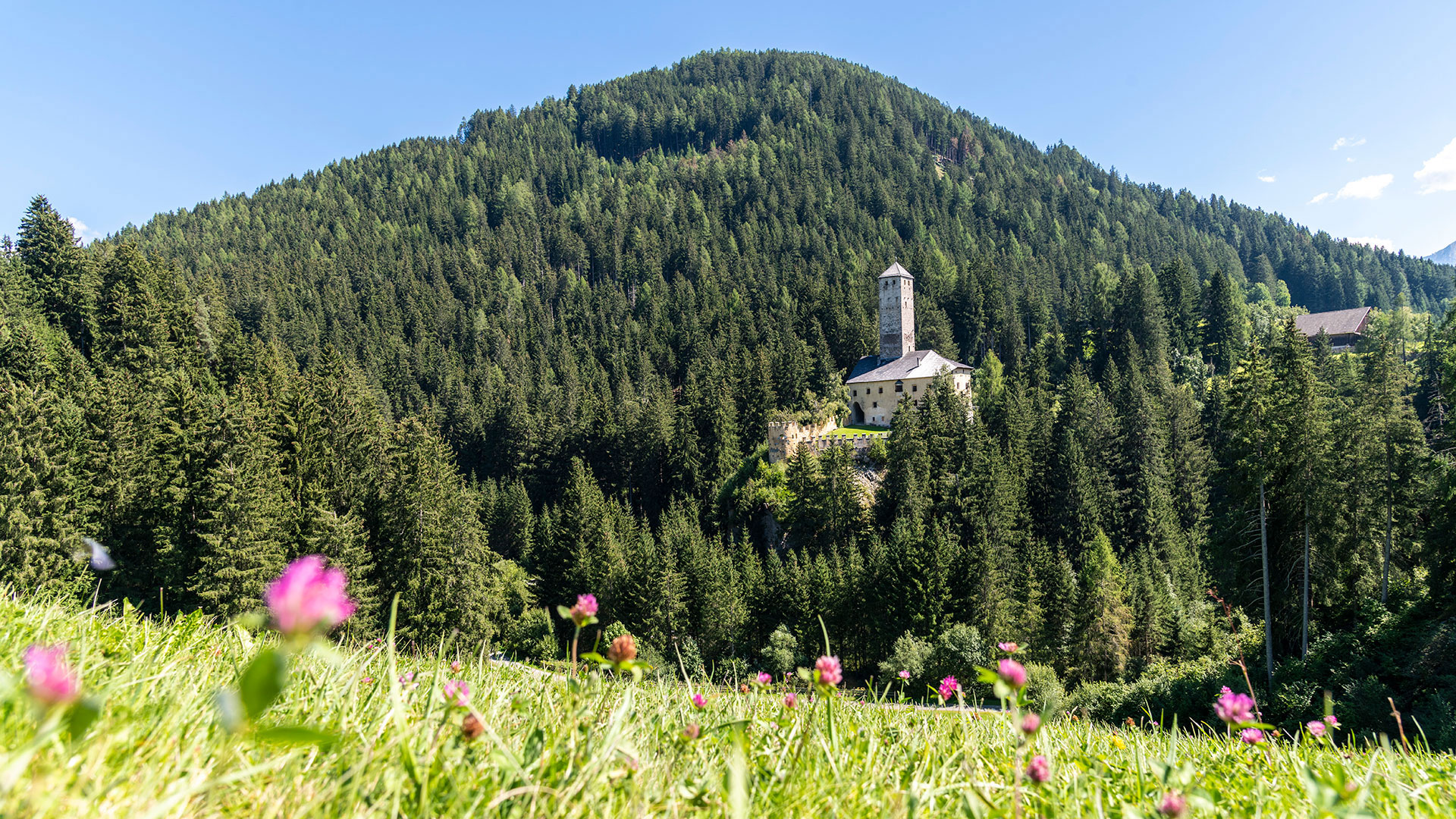
In 1996 the autonomous Province of Bolzano bought the Tor Castel with the intention of opening up a provincial museum. The museum named 'Museum Ladin Ciastel de Tor' is dedicated to the culture and to the history of the ladin ethnic group. The castle`s history brings us back to the 12th Century when the castle used to be the main court 'Thurn an der Gader'. Thanks to the museum, the story of the ladins of the Dolomites has, and indeed is, being spread: descendents of the antique roman population that used to live in this area are the oldest linguistic group out of the three linguistic groups in South Tyrol. With the help of multimedia the visitor can learn about the language, the culture and the history of the ladin population from the Dolomites. In the museum you can learn about archeology (the history of colonization, 'Sotciastel', from the Rheats to the Ladins), history (earls, lawyers, subjects), the Dolomites (formation, discovery, exploration), the ladin language and identity (linguistic laboratory, craftwork), the economy (residential center of the 'Viles', the Via Ferrata - iron path) and you can visit the observation point for ladin history ('Ladinoscope').
Schloss Thurn, Torstraße 72
39030 St. Martin in Thurn
Tel.0474/524020
Fax 0474/524263This email address is being protected from spambots. You need JavaScript enabled to view it.
www.museumladin.it
It may also interest you: